
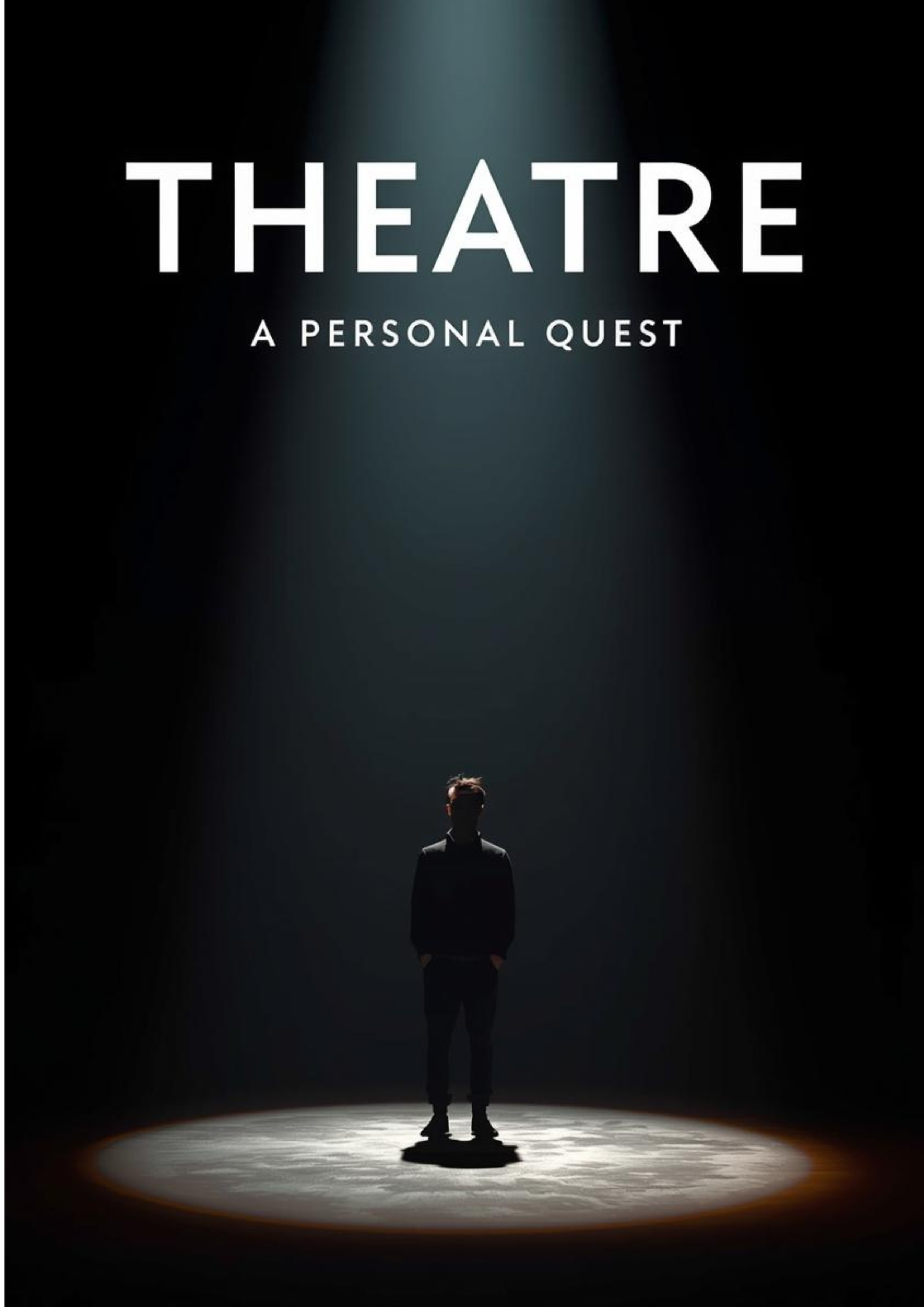
A question preoccupies me deeply: what do we present in Theatre today, and why? Why do we, ultimately, invite people to leave the comfort and warmth of their homes to come and share a living experience with us?
For some time now, I have observed a prevailing trend in many productions: a focus on pain, on the grim, on the dark. In an era when our daily lives are overwhelmed by hardship and suffering, I wonder: why does theater, as a space for live, collective encounter, insist on projecting the same dark landscape?
If one of the primary roles of Art—and of Theatre in particular—is to illuminate and elevate the human experience, to show us something more than the everyday, to remind us of the greatness hidden within the human spirit and soul… then why does this ascent seem so sorely lacking?
The darkness is there. We experience it and see it around us every day. The role of Theatre, I believe, is not simply to reproduce or confirm it. Its role is to illuminate it through transcendence—to cast upon it a light that reveals not only the depth of the darkness we all experience to some degree, but also the path that leads out of it. Human stories and human nature possess true grandeur, with the ancient Greek tragedies standing as a brilliant example. The critical question, then, is this: what do we wish to happen to the audience at the end of the journey? A dead-end, dark confirmation, or a sense of understanding, heroism, and transcendence born of a realignment with weakened or neglected values? A glimmer of hope, perhaps?
Here, I think, lies the gift of Theatre. Its unique offering—what sets it apart from every other art form—is the offering of catharsis.
Aristotle, in his Poetics, described catharsis as a therapeutic, purifying process arising from ‘pity’ and ‘fear.’ The audience is invited to experience the fears of the characters—the threat, the danger, their revelation—and through empathy, to recognise something in themselves and in others. Why? Because fear mobilises us to escape it. It activates our intellectual defences and leads to an inevitable “re-cognition”—a passage from ignorance to knowledge. Just as the tragic hero is compelled to recognise his true identity and that of others, so too do we inevitably discover the kinship that connects us to them. Conflict, born of ignorance, is transformed into resolution through this recognition. The drama resolves into knowledge—into a new, higher understanding and stance.
Theatre, therefore, does not invite us to a mere immersion in darkness. It calls us to a transformative journey through it. Within the sacred vessel of the performance, we watch Oedipus grapple with his fate or Antigone stand upright against political and social norms when they clash with higher—‘divine’—values, or what we might call the values of the “Higher Human.” This portrayal is a profound invitation: it is a call to take a stance, to discover the hero within ourselves who can rise again, against whatever has alienated the human existence from its profound nature, its soul, and its meaning.
Experiencing these emotions collectively, we do not leave the Theatre burdened. Paradoxically, we get liberated. The ‘sludge’ of our unaddressed fears and sorrows is stirred up, rises to the surface, and is cleansed, purified, healed. We leave not heavier, but renewed. Despair is overcome by a lucid understanding of the human condition and our transformed place within it.
This ancient wisdom is urgently contemporary. In a world of ‘scrolling,’ theater offers a rare, communal vessel for this deep, transformative, emotional alchemy. But for catharsis to occur, it requires far more than the depiction of pain. It demands a creative performative proposition that “earns” it: a dramaturgy of error recognised, a turning point, a resolution that offers meaning—not merely shock. Too many contemporary productions stop precisely at shock, depriving the audience of the crucial culmination: liberation and the return to clarity.
I remember leaving a Peter Brook production and feeling every molecule in my body pulse within me, as if being reborn—literally, without exaggeration. I experienced such an inner rebirth. I left the Theatre with a renewed purpose for life, a renewed responsibility toward myself and others. A newfound appreciation for the gift of being alive. A fresh opportunity to live with a beating heart, in a rapture of participation. With new consciousness. With new direction.
This is the ascent. It is not happiness. It is clarity. It is the light that strikes the prism of our weary, worn perspective and brings us a liberating, clearer image. The gift of Theatre is not to deliver ready-made messages, but to clean the lenses of our vision so that we may see everything more clearly. And when, if not now, is the need for this light more urgent?
Of course, Theatre is also entertainment. It is comedy, musical, farce. There are many genres. But even the most profound spiritual work can and should leave the spirit lighter, richer, elevated. A theatrical experience that ignores the ‘you,’ its audience, that leaves no room for breath or compassion, that fails to launch the purifying arrow of catharsis—such an experience loses, I believe, the highest calling of its function.
Today, I feel, Theatre is called, more than ever, to elevate our spirit, to cultivate our spirituality. To lift us from the narrow, repetitive experience of pain and to remind us—to usher us into—the higher meaning of life and our individual and collective evolution. It can do this by returning to its generative, sacred role as a space and means of catharsis.
In the end, the crucial question for every creator is this: what perspective do I offer through what I present to the human experience today? Does it trap us in the basement of human misery, or does it open for us—through the very act of witnessing—a glimpse of light? How does it help us see life, others, and ourselves through a different, more complete, more luminous prism? How can it transform the everyday life of each member of the audience?
Let me be clear: I am not talking about tidy happy endings or simplistic moral guides. I am talking about depth with breath. I talk about acknowledging the darkness, yet also the search—or at least the promise—of light, or even of catharsis. Why should I leave my home if all I find in the Theatre is a dark confirmation of the world that weighs me down? Why not find there, instead, the courage of Antigone—a reminder of my own need to stand upright against whatever tries to lower my gaze from the stars?
Let us invite our audience to rise with us. Let us offer them not only a mirror, but also a window—and the deep, collective catharsis that has been the unique gift of Theatre since its very birth. The gift of rebirth, of clarity, and of a new direction in life.
- Theodora Loukas